llama.cpp KV Cache Investigation
Applying range-addressed KV cache allocation to the llama.cpp memory layer

Abstract
The llama.cpp investigation applies the tagma coordinate principle to the llama.cpp KV cache. The cache layer (src/llama-kv-cache.*) assigns each token a cache cell and passes per-token index vectors into the attention graph, the structural counterpart of the vLLM block table. A contiguous-slot mode already exists in the cache, which is the entry point for range-addressed allocation. The reference benchmark (llama-bench) runs on CPU and Apple Silicon without an accelerator, so the proof surface is GPU-free. This page records the measured Phase A and Phase B results and the insights derived from them.
Benchmark method
The host-path microbenchmark lives in the fork at pocs/tagma-kv-bench and drives the real llama_kv_cache functions (find_slot, prepare, apply_ubatch, set_input_k_idxs, set_input_v_idxs) with synthetic ubatches, so the attention arithmetic is excluded and the numbers are the host-side KV bookkeeping in isolation. The measurements run on the CPU-only build (GGML_METAL=OFF, Release) on Apple M1 Max with Qwen2.5-0.5B-Instruct Q4_K_M at 32K context, matching the llama-bench baseline samples. The raw output is results/host-bench-ctx32768.txt in the fork.
Measured results
Baseline samples
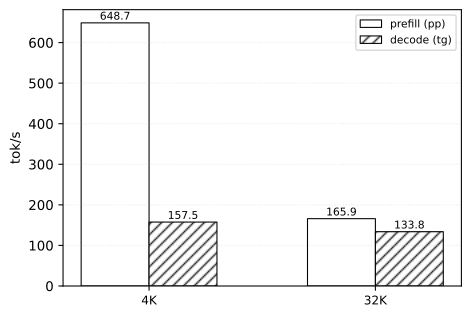
The llama-bench baseline samples on the CPU-only build, -p <len> -n 256 -ngl 0:
| Context | Prefill tok/s (pp) | Decode tok/s (tg) |
|---|---|---|
| 4096 | 648.7 | 157.5 |
| 32768 | 165.9 | 133.8 |
The 128K sample was dropped: on CPU it exceeds 45 minutes for a single sample, and the prefill drop is dominated by the quadratic attention cost, which is not a tagma signal.
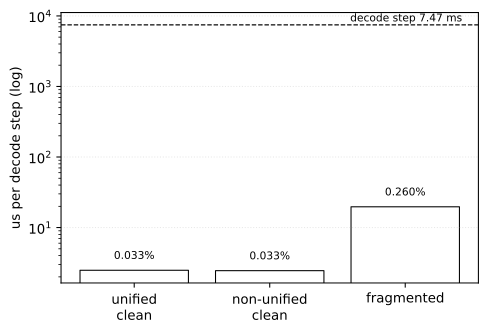
Host KV bookkeeping per decode step
| State | find_slot(false) | find_slot(true) | prepare | apply_ubatch | set_input_k/v | host total | decode share |
|---|---|---|---|---|---|---|---|
| Single sequence, unified, clean ring | 0.050 us | 0.038 us | 2.249 us | 0.194 us | 0.020/0.019 us | 2.482 us | 0.033 % |
| Single sequence, non-unified, clean ring | 0.055 us | 0.040 us | 2.228 us | 0.179 us | 0.021/0.020 us | 2.448 us | 0.033 % |
| Fragmented, eviction with 32 survivors | 0.935 us | 192.7 us | 17.06 us | 2.558 us | 0.061/0.026 us | 19.70 us | 0.26 % |
The decode share references the 32K decode step of 7.47 ms (133.8 tok/s).
Contiguity outcomes under eviction
The eviction scenario fills the unified ring to 90% with 64 interleaved sequences, removes every other sequence, then decodes with the 32 survivors over 500 steps.
| Metric | Value |
|---|---|
Decode-slot contiguity, is_contiguous |
8.0 % |
find_slot(cont=true) success, a run of 32 cells exists |
100 % |
find_slot(cont=true) search cost |
192.7 us |
| Per-sequence append adjacency, new cell equals previous cell plus one | 0.0 % |
Write scatter: set_rows versus dense copy
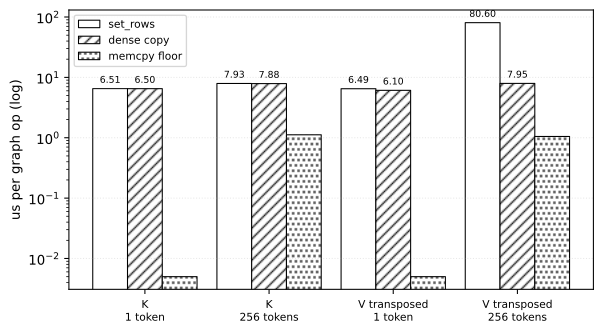
The comparison runs single-op graphs on the CPU backend with the thread count pinned to one, because GGML_OP_SET_ROWS always executes as a single task while GGML_OP_CPY executes with the backend thread count, and a four-thread single-op CPY graph pays a ~70 us thread-pool launch artifact that does not reflect the in-graph cost.
| Layout | set_rows | dense copy | memcpy floor |
|---|---|---|---|
| K, 1 token | 6.51 us | 6.50 us | 0.005 us |
| K, 256 tokens | 7.93 us | 7.88 us | 1.12 us |
| V transposed, 1 token (128 rows) | 6.49 us | 6.10 us | 0.005 us |
| V transposed, 256 tokens (32768 rows) | 80.6 us | 7.95 us | 1.05 us |
In-graph scatter share of decode
The decode profile (pocs/tagma-kv-bench/decode-prof.cpp) runs a real 16K prompt prefill and 512 single-token decode steps, with env-gated timing of ggml_compute_forward_set_rows in the CPU backend (TAGMA_PROF=1).
| Quantity | Value |
|---|---|
| set_rows calls (512 steps x 48 nodes) | 24576 |
| Average in-graph set_rows node time | 0.700 us |
| set_rows per decode step | 33.6 us |
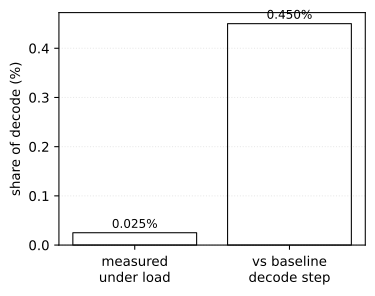
| Measured share of decode wall (machine under load) | 0.025 % |
| Share against the baseline decode step (7.47 ms at 32K) | 0.45 % |
The single-op graph benchmark overestimates the in-graph per-node cost by roughly an order of magnitude: the ~6 us fixed dispatch is amortized inside the real graph, and the node executes at ~0.7 us. The in-graph scatter share of decode is below one percent by either normalization.
Insights
- The
preparesnapshot and restore dominates the bookkeeping at 2.2 us of the 2.5 us per decode step and stays flat at ~0.5 us per token for chunked ubatches across fill factors from 25% to 97%. - Fragmentation raises the base cell scan from 0.050 us to 0.935 us, a 19x increase, while the contiguous-run search rises from 0.038 us to 192.7 us. The contiguity verification is the expensive operation, and the default path never pays it.
- Unified mode interleaves the sequences, measured at 0.0% per-sequence adjacency and 8.0% decode-slot contiguity under eviction. The read path consumes the ring sequentially through the contiguous per-stream view, so the interleaving does not fragment the CPU read pattern.
- The per-op graph dispatch dominates the write scatter at ~6 us for both set_rows and the dense copy against a 0.005 us memcpy floor. The only material gap is the transposed V layout at 256-token chunks, 80.6 us versus 7.95 us, a prefill-only case at roughly 0.13% of the 32K prefill wall time.
- The llama.cpp KV path is array-indexed: cells, streams, and layers are dense arrays with arithmetic addressing. The hash-IO replacement that the tagma map work targets has no counterpart in this path, because the per-token indirection is a row scatter and no hash lookup participates in the KV path.
Status
The Phase A and Phase B measurements on the CPU-only build are recorded above. The Phase A gate asks whether the KV access path is a measurable share of decode time, and the measurements answer it: the host-side KV bookkeeping is 0.033 % of the decode step on a clean ring and 0.26 % under fragmentation, and the in-graph write scatter is 0.025 % measured and 0.45 % against the baseline step. The tagma range-addressed intervention removes exactly these costs, so within the llama.cpp KV path on the CPU surface it has no measurable performance basis. The read path is already range-based and the KV structures are array-indexed, so the hash-IO replacement that the tagma map work targets has no counterpart in this path.
The investigation continues. The remaining items are the SWA variant on a sliding-window model and the GPU-side behavior, which stays on the vLLM CUDA track; the hash-IO replacement value of the tagma map work is scoped as a separate investigation.
Conclusion
The Phase A gate measured a negative result on the tested CPU surface: the host-side KV bookkeeping and the write scatter sit at 0.025 to 0.45 percent of decode time, and the read path is already range-based. The tagma range-addressed intervention removes exactly these costs, so within the current llama.cpp KV path it has no measurable performance basis.
The entry point is structural and future. If llama.cpp adopts a vLLM-style paged KV cache, a shared block pool with per-sequence block tables, the block-table indirection that the current design lacks will appear, and the tagma range-arithmetic intervention gains a structural target: contiguous range allocation from the shared pool delivers the same memory efficiency without the block table. The measured lesson bounds the expectation for that scenario: the removable share equals the size of the indirection the paged design introduces, in the same 0.03 to 0.45 percent class measured here. The value framing is therefore paged-class memory efficiency without the block-table indirection, not a large speedup.
The adoption of a paged design is an upstream decision. The track remains parked with the open scope recorded in the fork investigation notes: the SWA variant, unified-mode locality, GPU-side behavior, and the paged-adoption trigger.