Message Us
Other Formats
Foundation Activities for External Cooperation and Joint Value Creation
Works are the foundation’s technical and non-technical activities conducted with external institutions, open-hardware communities, and independent researchers, aligned with the direction, philosophy, and charter. Every work is judged by a demonstrable artifact delivered in cooperation with a partner. This page is the comprehensive overview: the basic direction, the ecosystem strategy, the fields of works, and the engagements currently in motion.
A work is an activity of the SSCCS Initiative conducted with an external party: a research institution, an open-hardware community, an industry partner, or an independent researcher. Works span technical and non-technical fields, and every work is aligned with the foundation’s direction, philosophy, and charter. The foundation is independent, open-source, and operates as a foundational technology provider; its core technology is released under Apache 2.0. Works are the mission expressed in cooperation with external parties. The governing references are the Direction, the Philosophy, the Axioms, and the Foundational Charter.
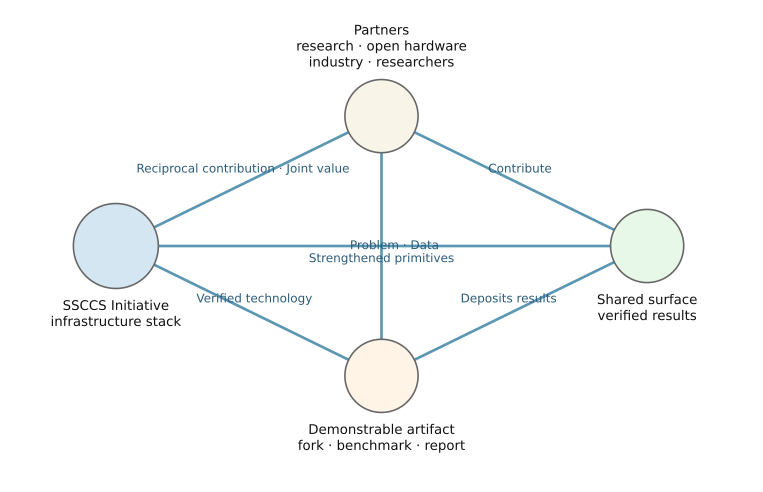
The direction document defines the foundation’s basic posture for partnership, collaboration, and support. SSCCS partners with academia, industry, open-hardware communities, and independent researchers, selected by technical merit and reciprocal contribution. The computing industry is mid-restructuring, so the foundation is deliberate about whom it works with. In the agentic era, declaring a feature costs nothing and the value of declaration converges to zero; what retains value is the structure that actually runs, compiles, and compounds across domains without human intermediation. Engagements follow three principles:
Validation is the ultimate currency. We operate as an open-source solution provider. When traditional capital is hesitant to invest directly, we go directly by introducing our validated primitives directly to engineering teams and venture portfolio companies for real-world workload evaluation. A work begins with a proven primitive and ends with a measured result on the partner’s own ground.
Permissionless: identify a long-neglected bottleneck in widely used infrastructure, map it to one of the foundation’s primitives, deliver a minimal solution with measurements, publish the source, and absorb the validated results. The validation is the return, accumulating as proven primitives, measurement data, and independence from institutional approval. The full statement lives in Direction: Partnership, Collaboration, and Support.
The ecosystem skeleton gives works their strategic shape: from verification to economy. Computation is structural observation; physical reality is captured through synthesis; verified results become economic assets that carry contribution obligations. The ecosystem operates on four axes:
Every verified result is committed immutably to the shared surface; that commitment turns the result into an asset and its creator into a contributor with a long-term obligation. The economic primitive is a verification result, a single bit anchored to reproducible physical ground truth. Staking externalises funding, downstream reuse creates royalties, and the metabolic contract ensures that no participant draws from the shared surface indefinitely without feeding it back. Works conducted under this strategy are operations of a single self-replicating structure. The full model is described in Ecosystem Skeleton.
Works are conducted in technical and non-technical fields. Every work is judged by a demonstrable artifact: a fork, a benchmark, a measured report.
Technical fields:
Non-technical fields:
The codebases behind the technical fields live under Projects.
The engagements below are the works currently in motion. This section is supplementary and changes as works progress.
| Work | Institution | Artifact | Status |
|---|---|---|---|
| LLM Serving Engines | vLLM and llama.cpp open-source communities | Coordinate-indexed KV cache backend on the SSCCS vLLM fork; llama.cpp investigation measured and parked with an open scope | In progress, vLLM GPU benchmark pending |
| DuckDB Coordinate Lattice | DuckDB open-source community | Coordinate-lattice access path for multi-dimensional point and range queries; profile gate and prototype planned | Investigation planned |
| CERN Collaboration Framework | CERN | Framework draft for open-science engagement | Proposal |
| ROOT TTree Bottleneck | CERN | Development plan and measured report | Report published |
| SSCCS Validation with OpenHW CORE-V Ecosystem | OpenHW Group | Phased integration roadmap | Proposal |
| ExaVerif Contribution to RISC-V | RISC-V Foundation | ExaVerif contribution and joint collaboration | In progress |
| SSCCS × AWS Strategic Collaboration Roadmap | AWS | Phased collaboration proposal | Discussion |
Flagship works are chosen by mission alignment. The archetype is an engagement with a research or industry institution: the partner’s ecosystem stays intact, and the work is delivered as a measured artifact on the partner’s own data and access pattern.
Each engagement follows a bounded sequence: alignment through a framework or proposal, a bounded demonstration through a development plan, a measured result against the partner’s own baseline, and an integration decision that belongs to the partner. The foundation’s role ends at the boundary it defined.
Engagements begin with a concrete problem. If your institution or startup portfolio faces workloads where data movement, verification, or I/O dominates the cost, the starting point is the A Foundation for Energy-Efficient and Trustworthy Computing.
For VC ecosystems: if direct investment is not a fit, we welcome the opportunity to introduce our validated open-source infrastructure to your portfolio companies for technical evaluation.
Our trajectory is sustained by founder-led community support and transparent technical narratives. The direct route for collaboration or community sponsorship is a message to co@ssccs.org.