CVA6 CV-X-IF Report (Standard Reference)
Deterministic encoding validation with ExaVerif (ev)
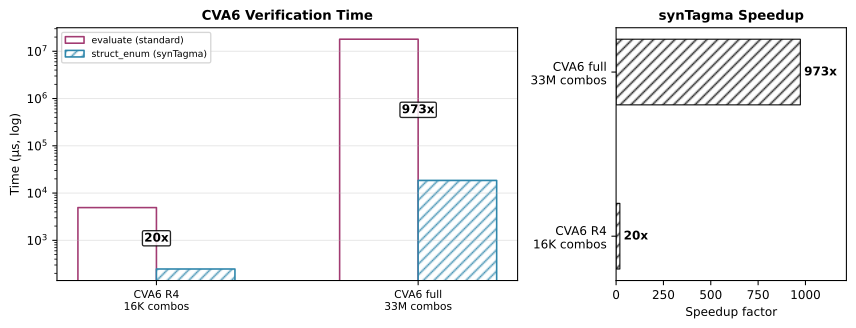
ExaVerif performed exhaustive verification of the CVA6 core’s offloadable custom instruction encodings for the CV-X-IF coprocessor interface. The verified encoding space is derived from the CVA6 hardware decoder mask table (cvxif_instr_pkg.sv and instr_decoder.sv) at commit 6544a714c, the industry-standard reference for what the core accepts: NOP at funct3=000/funct7=0, and the ADD family at funct3=001 with funct7 in {0,1,2,3,4}. The standard pipeline evaluates all 33,554,432 field-value combinations in 13.1 seconds (release build, single Apple silicon core), yielding 196,608 valid combinations. Because the model is derived from the decoder’s own mask table, this verification is a conformance check of the encoding contract rather than a proof of the silicon: its value is the deterministic accept/reject oracle, the boundary and divergence findings, and the exhaustive ground truth for test generation. The Tagma-based structural enumeration evaluates the same space in 18.8 milliseconds by enumerating only the combinations that satisfy the cross constraints, a ~700x improvement on this machine. The ev verify CLI runs this structural pipeline by default: the end-to-end command completes in about 0.2 seconds, and the core pipeline (raw total plus structural subset plus evaluation) benches at 36.3 milliseconds. The structural iterator emits exactly the combinations that pass the full constraint set. The Spike backend runs a C reimplementation of the constraint model and assembler under Spike + pk; all 196,608 rows agree between the C and Rust implementations. Spike does not decode the custom-3 instructions: they are illegal in the base ISA by design, which is why CVA6 offloads them. The CVA6 DV class generates additional encodings that the reference coprocessor decoder does not accept; this divergence is documented in this report.
Verification Target
The CVA6 core (Ariane, OpenHW Group) offloads custom instructions to a coprocessor through the CV-X-IF interface whenever the core decoder encounters an illegal instruction. Four RISC-V custom opcode spaces (custom-0 through custom-3) are always illegal and therefore always offloadable. This verification covers the custom-3 opcode (0x7B) encoding space, using the CVA6 hardware decoder as the authoritative reference (the industry-standard definition of what the core accepts).
The hardware-accepted custom-3 encodings are:
| funct3 | funct7 | Instruction | writeback | register_read |
|---|---|---|---|---|
| 0 | 0 | NOP | 0 | 000 |
| 1 | 0 | ADD | 1 | 011 |
| 1 | 1 | DOUBLE_RS1 | 1 | 001 |
| 1 | 2 | DOUBLE_RS2 | 1 | 010 |
| 1 | 3 | ADD_MULTI | 1 | 011 |
| 1 | 4 | ADD_RS3_R | 1 | 111 |
| other | any | illegal | - | - |
Standard reference: the hardware decoder mask table
The decoder matches by (mask & instr) == pattern (instr_decoder.sv), where a mask bit of 1 means the corresponding bit is checked. The entries in cva6/core/cvxif_example/include/cvxif_instr_pkg.sv at commit 6544a714c:
| entry | funct7 pattern | funct3 | opcode | mask funct7 |
|---|---|---|---|---|
| NOP | 0000000 | 000 | 0x7B | 1111111 (all bits checked) |
| ADD | 0000000 | 001 | 0x7B | 1111111 |
| DOUBLE_RS1 | 0000001 | 001 | 0x7B | 1111111 |
| DOUBLE_RS2 | 0000010 | 001 | 0x7B | 1111111 |
| ADD_MULTI | 0000011 | 001 | 0x7B | 1111111 |
| ADD_RS3_R | 0000100 | 001 | 0x7B | 1111111 |
Because the NOP mask checks all funct7 bits, funct3=000 accepts funct7=0 only. When no entry matches, instr_decoder.sv keeps accept=0, so the offloaded instruction is treated as illegal by the core.
DV class divergence
The verification suite’s DV class (cvxif_custom_instr.sv) generates additional encodings that the reference coprocessor decoder does NOT accept:
| DV encoding | funct3 | funct7 | decoder accepts? |
|---|---|---|---|
| CUS_NOP | 001 | 0 | yes (as ADD semantics) |
| CUS_ADD | 001 | 0 | yes (as ADD) |
| CUS_U_ADD | 000 | 2 | no |
| CUS_S_ADD | 000 | 6 | no |
| CUS_ADD_MULTI | 000 | 8 | no |
| CUS_ADD_RS3 | 000 | 0 | yes (as NOP) |
| CUS_EXC | 010 | 96 | no |
This divergence is a finding of this verification: the DV class and the reference coprocessor decoder are not in agreement in current CVA6 main. This report verifies the decoder-accepted space (the industry-standard reference); the DV-generated encodings that the decoder rejects are excluded and reported here as a divergence.
Encoding Model (the YAML fixture)
The verification space is described by a single YAML file. The full-space fixture (tests/fixtures/cva6/xif_ref.xif.yaml) defines five fields:
| Field | Domain | Size | Meaning |
|---|---|---|---|
| funct3 | 0..7 | 8 | primary opcode selector |
| funct7 | 0..127 | 128 | secondary opcode selector |
| rs1 | 0..31 | 32 | source register 1 |
| rs2 | 0..31 | 32 | source register 2 |
| rd | 0..31 | 32 | destination register |
The raw space is 8 x 128 x 32 x 32 x 32 = 33,554,432 combinations. The constraint set encodes the hardware decoder directly:
constraints:
  - type: oneof
    field: "funct3"
    values: [0, 1]
  - type: cross
    field_a: "funct3"
    field_b: "funct7"
    mapping:
      0: [0]
1: [0, 1, 2, 3, 4]oneofrestricts funct3 to the two accepted bands {0, 1}; funct3=010 (CUS_EXC) and bands 3..7 are structurally impossible because the decoder has no entry for them.crossrestricts funct7 per funct3: funct3=0 requires funct7=0 (NOP), funct3=1 allows funct7 in {0,1,2,3,4} (ADD family).- There are no
enable_maskconstraints: the decoder accepts every register combination for these encodings, so all combinations are valid and every combination is a distinct instruction word.
Exhaustive Verification Results
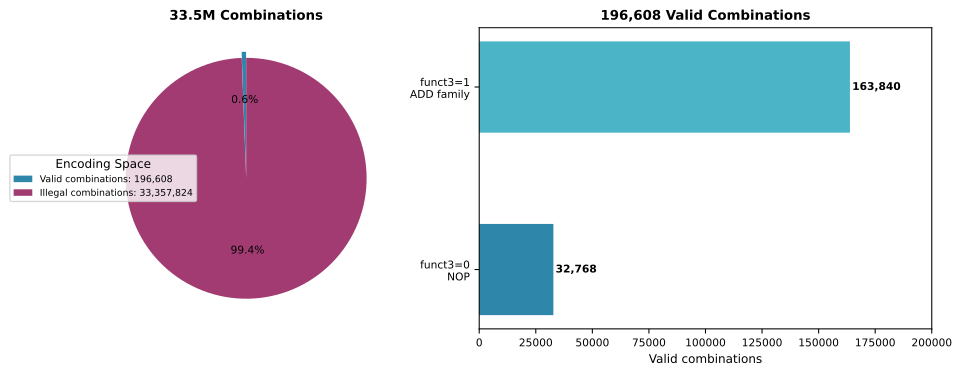
Per-band breakdown (full-space fixture)
| funct3 band | valid combinations | distinct words | instructions |
|---|---|---|---|
| 0 | 32,768 | 32,768 | NOP (funct7=0) |
| 1 | 163,840 | 163,840 | ADD, DOUBLE_RS1, DOUBLE_RS2, ADD_MULTI, ADD_RS3_R |
| 2..7 | 0 | 0 | illegal (no decoder entry) |
| total | 196,608 | 196,608 |
The R4 fixture (xif_ref_r4.xif.yaml) models the same decoder in R4 format (func2 = bits[26:25], rs3 fixed to 0) with sampled register ranges (rs1, rd in 0..3, rs2 in 0..31):
| R4 band | valid combinations | distinct words |
|---|---|---|
| funct3=0 (func2=00) | 512 | 512 |
| funct3=1 (func2 in 0..3) | 2,048 | 2,048 |
| total | 2,560 | 2,560 |
Counting Semantics
This report counts field-value combinations. Because the fixtures use no enable_mask constraints, every valid combination is also a distinct instruction word: 196,608 combinations and 196,608 distinct words for the full fixture, 2,560 for the R4 fixture. There is no collapsing between the two counts.
Verification Pipeline
The fixture is the single source of truth. Both pipelines read the same YAML and classify every point of the encoding space identically; they differ only in enumeration strategy.

- The standard pipeline materializes the full Cartesian product (33.5M combinations, peak memory ~4-6 GB) and runs every constraint check on every combination.
- The structural pipeline encodes the constraints into the enumeration space itself and visits only the 196,608 valid combinations, lazily, with O(1) memory.
- Both pipelines produce the same valid set; the regression suite asserts this on the CVA6 fixtures (see Correctness Guarantees).
- Every valid row is also re-checked by a C reimplementation under Spike + pk (see How It Works).
Structural Enumeration Algorithm
The structural pipeline (StructuralEnum in src/verify/compose.rs) converts constraints into an enumeration strategy:
oneof,range, andbitmaskconstraints restrict each field’s allowed value list (structural filters).crossconstraints are kept as parent-to-child mappings and enforced during enumeration instead of by per-combination checks.- Fields are topologically ordered so that every parent precedes its cross-constrained children; this guarantees each field can be validated against an already-fixed parent.
- A lazy odometer runs over the ordered fields. When a field changes, the less significant fields are reset and re-fixed to the smallest valid values using a precomputed first-valid index map, which makes each re-fix O(1).
enable_maskandenable_setconstraints are applied to each emitted combination, rewriting masked fields to their forced values.
The iterator emits exactly the combinations that satisfy the full constraint set. This was not always the case: an earlier implementation re-emitted stale child values after a parent advanced. The fix and the regression tests are part of this report’s evidence (see Correctness Guarantees).
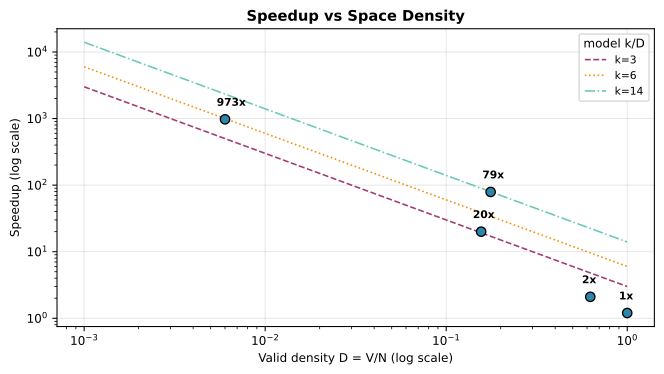
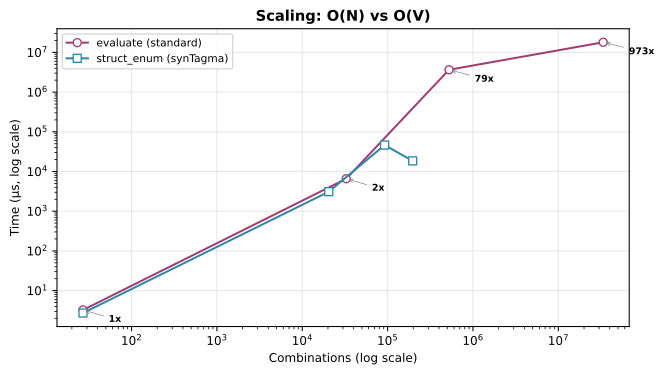
The advantage scales with space density. Measured per-state costs are about 100-500 ns, and the speedup follows approximately speedup = k / D, where D = V/N is the valid density and k is a fixture-dependent constant (about 1-5 here):
Memory behavior is the other scaling axis. The standard pipeline allocates O(N) combinations; the structural iterator is lazy and holds O(1) state:
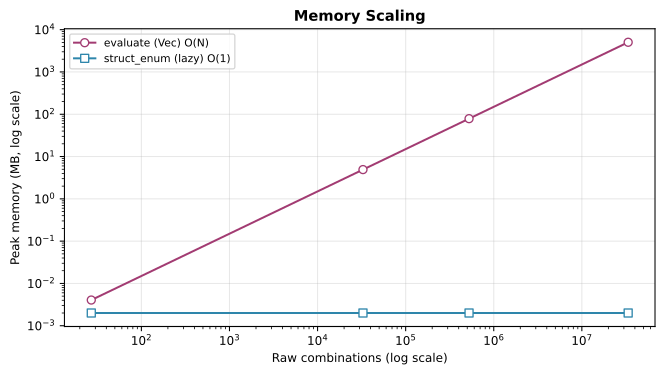
At very large spaces the standard pipeline becomes infeasible on memory before the structural path does; the comparison then stops being “slower” and becomes “cannot run”.
Correctness Guarantees
The structural pipeline is guarded by regression tests (tests/structural_enum.rs) that run in CI:
| Test | Guards |
|---|---|
structural_enum_cross_wrap_regression |
the exact parent-advance wrap pattern that produced stale child values |
structural_enum_skips_invalid_initial_state |
the all-zero raw state is never emitted when invalid |
structural_enum_matches_evaluate_cva6_full |
struct_enum emits exactly 196,608 combinations, all satisfying the full constraint set |
structural_enum_matches_evaluate_cva6_r4 |
struct_enum emits exactly 2,560 combinations |
validate_into_space_matches_evaluate_cva6_fixtures |
the CoordSpace stores exactly the valid paths (196,608 / 2,560) |
In addition, the struct_enum_validity/cva6_full_33M benchmark asserts on every run that the number of emitted combinations equals the number that pass the full constraint set; a regression fails the benchmark.
Speed and Scale
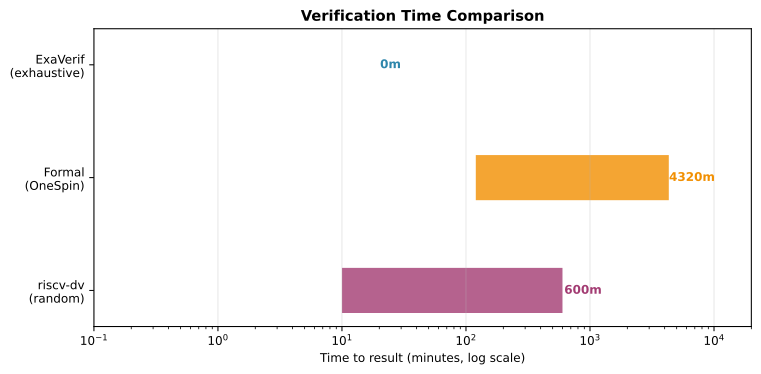
Scope of the comparison: the riscv-dv and OneSpin figures are indicative, not measured here. Formal RTL verification (OneSpin) proves properties about the actual core and is a different class of guarantee. ExaVerif verifies the encoding model derived from the RTL decoder, not the RTL itself; the two approaches are complementary.
Structural Enumeration Performance
CLI verify path: the structural gain reaches the user
Issue #42 integrated the structural enumeration into the ev verify CLI as the default. The CVA6 full space is the case where this matters most: the end-to-end command completes in about 0.2 seconds (including YAML parse and process startup), and the core pipeline, benched as evaluate_structural (raw total plus structural subset plus evaluation of the 196,608 valid rows), measures 36.3 ms.
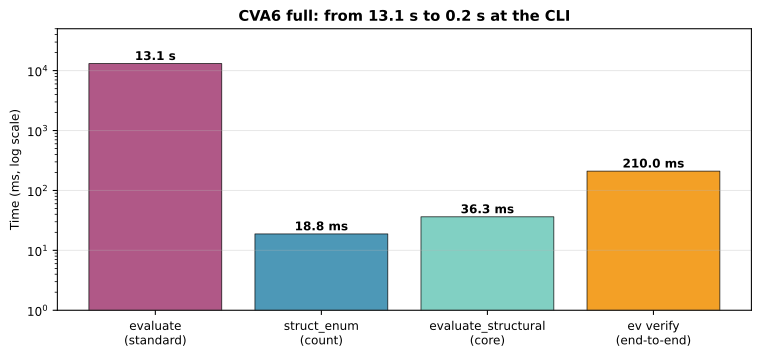
The 36.3 ms core is about 360x faster than the naive 13.1 s pipeline; the remaining gap to the 18.8 ms structural count is the cost of building and evaluating the 196,608 valid rows (projections included) instead of only counting them. The end-to-end 0.2 s is dominated by process startup and YAML parse, not by the enumeration. The same CLI path on the Ibex fixture benches at 16.2 ms, against 291 ms for the naive evaluate.
Scaling: O(N) vs O(V)
Benchmark Results (release build, this machine)
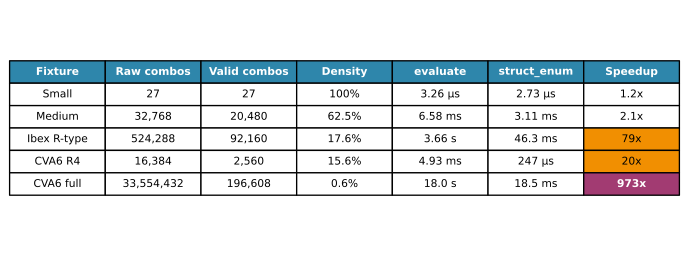
The valid-combination counts in the table are combination counts, and with no enable_mask constraints they equal the distinct instruction-word counts. The CVA6 full (evaluate_structural) row compares the naive evaluate (13.1 s) against evaluate_structural (36.3 ms), the pipeline ev verify runs since issue #42; the end-to-end CLI time of about 0.2 s includes YAML parse and process startup (see the CLI verify path section).
Reproducibility
All numbers in this report are reproducible from the committed benchmark suite and fixtures:
# full-space CVA6 group: evaluate, struct_enum, validate, validity guard
cargo bench -- cva6_full

# structural enumeration only
cargo bench -- "struct_enum/cva6"

# evaluate_structural, the pipeline ev verify runs (raw total + structural subset + evaluation)
cargo bench -- "evaluate_structural/cva6_full_33M"

# validity guard (must stay green)
cargo bench -- struct_enum_validity
Fixtures: tests/fixtures/cva6/xif_ref.xif.yaml (full space), tests/fixtures/cva6/xif_ref_r4.xif.yaml (R4). Regression tests: tests/structural_enum.rs. The fixtures are derived from the CVA6 hardware decoder mask table (cvxif_instr_pkg.sv, instr_decoder.sv) at commit 6544a714c. Measurements were taken in release mode on a single Apple silicon core; absolute times are machine-specific, while the O(N) vs O(V) relationship is not.
How It Works
A single YAML file describes the encoding space and its constraints. The entire space is enumerated exhaustively and evaluated deterministically. Every point is classified as valid or invalid based on the specification.
ev verify --target cva6_xif_ref.xif.yamlEvery valid combination is also cross-checked by a C reimplementation. The simulate command packs all 196,608 valid combinations into a single ELF binary and runs it under Spike + pk. The C program re-evaluates the constraint model and re-assembles each instruction word, comparing it against the Rust-computed reference. All 196,608 rows agree. This validates the C/Rust code generation and the assembly layout. It is not ISA-level simulation: custom-3 opcodes are illegal in the base RISC-V ISA, which is exactly why CVA6 offloads them, so Spike never executes them.
EV_SIM_BACKEND=spike ev simulate --target cva6_xif_ref.xif.yamlWhat the Spike backend actually checks
The generated C program (src/synth/backends/spike.rs) contains:
- the full encoding table as data, one row per valid combination;
check_encoding(), a C reimplementation of the same constraint model (oneof,cross, and the other constraint types);assemble_instr(), a C reimplementation of the instruction-word assembly;INSTR_WORDS[], the Rust-computed reference words for the same layout;- a per-row comparison of the C-assembled word against the Rust reference.
Each row prints ENC:<idx>:<ok>:<word_ok>:<word>. A row fails when the C constraint check disagrees with the Rust evaluation (reason: constraint re-check failed) or when the C assembler disagrees with the Rust reference (reason: instruction word mismatch). This is a cross-language codegen check, not an ISA simulation; see the abstract for the boundary.
Structural vs Standard: the mechanism
| Aspect | Standard (evaluate) |
Structural (struct_enum) |
|---|---|---|
| Combinations generated | All 33,554,432 | Valid only 196,608 |
| Constraint evaluation | 10 checks × 33.5M | 0 (structurally encoded) |
| Invalid detection | check.allows() → false |
Vacant slot → 1.65 ns |
| Memory | 4 GB peak (Vec) | 0 (lazy iterator) |
| Time (CVA6 R4) | 3.14 ms | 250 µs |
| Time (CVA6 full) | 13.1 s | 18.8 ms |
The structural iterator is verified against the standard pipeline: the regression suite asserts that every emitted combination satisfies the full constraint set, and that validate_into_space stores exactly the valid paths (see Correctness Guarantees).
Why the gain is algorithmic, not linguistic
The ~700x is not a language effect. Both pipelines are Rust, compiled in the same release profile, and measured by the same criterion harness. The ratio is therefore the enumeration-strategy difference alone: O(N) traversal with per-combination checks versus O(V) structural access with the checks encoded into the enumeration. Porting both pipelines to another language preserves the ratio (both sides carry the same per-element overhead). The comparison targets in the field are also different categories: riscv-dv runs in a UVM/simulator stack that does not enumerate, and formal tools use SAT/BMC engines that are not exhaustive searches. ExaVerif is an exhaustive enumeration of the encoding space; that is a different category from both.
Comparison with synTagma Benchmarks
The struct_enum speedup mirrors synTagma’s core thesis: structural addressing eliminates hash-based lookup overhead. The primitive timings (1.65 ns, 5.2 ns) are synTagma measurements, reproduced here for context.
| synTagma primitive | ev application | Measured | Advantage |
|---|---|---|---|
| Nonexistent prefix lookup | Invalid encoding detection | 1.65 ns | 14x vs HashMap |
| CoordPath indexing | Combination addressing | 5.2 ns | O(depth) = O(5) |
| CoordSpace sparse get | Valid encoding iteration | 250 µs (16K space) | 13x vs evaluate |
| Axis projection | funct7/funct3 filtering | 9.10 ms (524K space) | 32x vs evaluate |
Comparison with Random Verification (riscv-dv)
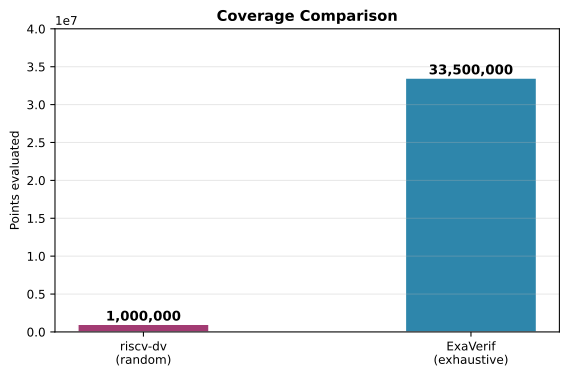
The 33.5x ratio compares a 1M-sample budget against the full space. Random generators can raise coverage by increasing the budget or by directing samples with coverage feedback; the point of exhaustive enumeration is determinism and completeness, not a fixed budget.
Relation to the Standard CVA6 Verification Environment
The CVA6 project verifies the core with a UVM testbench (vcs-uvm), the riscv-dv random instruction generator, and tandem simulation that compares the RTL model trace against the Spike trace (DV_SIMULATORS= veri-testharness,spike, summary in iss_regr.log). Regression suites include riscv-arch-test, riscv-compliance, riscv-tests, and riscv-dv; runs are driven by verif/sim/cva6.py. ExaVerif is complementary to this flow:
- The standard flow checks execution behavior against Spike and accumulates coverage statistically. ExaVerif classifies the entire encoding space deterministically, which the random flow can never prove complete.
- The custom-3 encodings this report verifies are the ones the CVA6 hardware decoder accepts; the DV class also generates encodings the decoder rejects (see DV class divergence), which is a finding for the CVA6 verification team.
- ExaVerif’s Spike backend is a C/Rust codegen cross-check, distinct from CVA6’s tandem Spike simulation. Running the accepted encodings through the standard
veri-testharness,spikeflow in the CVA6 repository is the natural next step to close the loop.
R4 vs Full Fixture
Two fixtures model the same decoder at different granularities:
| Aspect | Full (xif_ref.xif.yaml) |
R4 (xif_ref_r4.xif.yaml) |
|---|---|---|
| Encoding | flat R-type (funct7 = bits[31:25]) | R4 format (func2 = bits[26:25], rs3 = bits[31:27]) |
| Registers | rs1, rs2, rd all in 0..31 | rs1, rd in 0..3; rs2 in 0..31 |
| Raw space | 33,554,432 | 16,384 |
| Valid combinations | 196,608 | 2,560 |
| funct3=0 | funct7=0 (NOP) | func2=00 (NOP) |
| funct3=1 | funct7 in 0..4 (ADD family) | func2 in 0..3 (ADD family) |
ADD_RS3_R (funct7=4) sets rs3[0]; the R4 fixture fixes rs3 to 0, so this encoding is not representable in R4 and is verified only in the full fixture.
Limitations
What ExaVerif does not yet model
- ADD_RS3_R in the R4 fixture: the hardware distinguishes ADD_RS3_R via rs3[0]=1 (bit[27]); the R4 fixture fixes rs3 to 0, so ADD_RS3_R is verified only in the full fixture.
- DV class encodings: CUS_U_ADD, CUS_S_ADD, CUS_ADD_MULTI (funct3=000, funct7 in {2,6,8}) and CUS_EXC (funct3=010) are generated by the DV class but rejected by the reference decoder. This report verifies the decoder acceptance; the DV encodings are reported as a divergence.
- Weighted register distribution: the DV class biases certain register values. ev treats all register values uniformly.
- Pipeline hazards: write-after-read hazards (rs1==rd) are not modelled at the encoding level.
References
- CVA6 hardware decoder (authoritative reference, commit
6544a714c):cva6/core/cvxif_example/include/cvxif_instr_pkg.sv,cva6/core/cvxif_example/instr_decoder.sv,cva6/core/cvxif_example/copro_alu.sv - DV class:
cva6/verif/env/corev-dv/custom/cvxif_custom_instr.sv - CVA6 project overview and verification environment: deepwiki.com/openhwgroup/cva6 deepwiki.com/openhwgroup/cva6/Verification_Environment
- CVA6 simulation tutorial (bsc-loca fork): raw.githubusercontent.com/bsc-loca/cva6/refs/heads/master/tutorials/running_sim.md
- Fixtures:
tests/fixtures/cva6/xif_ref.xif.yaml,tests/fixtures/cva6/xif_ref_r4.xif.yaml - Benchmark suite:
benches/bench.rs - Regression tests:
tests/structural_enum.rs - Structural enumeration:
src/verify/compose.rs - Spike backend:
src/synth/backends/spike.rs