Telos
General agent runs as a fleet of peers with coordinate teleport
Telos is a general end-tier agent execution runtime within the SSCCS’s execution infra stack. Operating under the kineTics framework and supervised by the actus hub, Telos bridges LLM-driven planning with deterministic system effects.
Commands arrive via the actus contract, spatial coordinates are resolved, and Telos materializes these intents into concrete filesystem, process, or network operations. The runtime is strictly general-purpose, executing without binding to a specific language or domain.
Translating directory trees into spatial memory. Telos replaces traditional hierarchical agent traversal with coordinate-based addressing. By indexing the underlying worktree into tagma coordinates, the agent resolves locations in \(O(1)\) time, teleporting directly to relevant buffers rather than performing sequential directory descents.
Native Execution Architecture
Telos is distributed as a statically linked, standalone native binary.
- Zero-Dependency Deployment: The entire node is packaged in a single ~45MB executable. It requires no runtime, interpreter, daemon, or external dependencies.
- Ownership-Checked Concurrency: The agent core operates on OS threads with compile-time data race guarantees. CPU-bound workloads—such as language analysis, LSP traffic, and large-scale indexing—utilize a native thread pool for maximum core utilization.
- Bounded Resource Footprint: Each node maintains absolute ownership of its memory space and thread pool, ensuring execution overhead remains deterministic and predictable under heavy load.
Fleet Topology & Orchestration

A single Telos binary operates as a complete execution node. The fleet scales horizontally across two axes:
- Process Isolation: Nodes execute as independent OS processes. They share no runtime or interpreter state, delegating scheduling entirely to the underlying operating system to prevent application-level lock contention.
- Stigmergic Coordination: The fleet operates without a central planner. Nodes deposit operational facts and traces into the neXus coordinate space. Peer nodes read these deposits asynchronously, adapt to findings, and propagate corrections. This yields a highly resilient, peer-coordinated network with no single point of failure.
Deployment is orchestration-free. A node exists simply because the binary exists on disk—whether at a project root, in a CI runner, or in a container.
Linear Scaling Economics
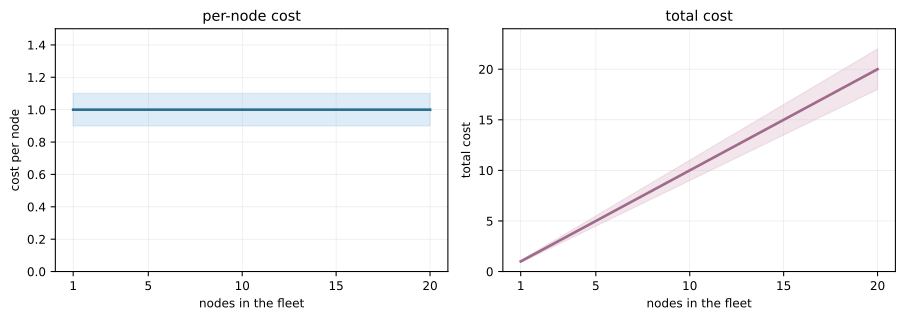
The architectural constraints of Telos guarantee strictly linear cost scaling. Server compute and LLM token expenditures scale directly with the workload; structural overhead remains flat. Because resource utilization per node is strictly bounded, the unit economics are identical whether running one node or one thousand.
Interfaces and Boundaries
- The Actus Contract: Telos maintains a strict 1:1 WebSocket contract with the actus hub. Actus provisions the binary, and Telos responds with readiness, telemetry, and command output. The protocol relies on eight upstream event types and three downstream command types, ensuring deterministic handling of turn-end replay filtering, state overwriting, and terminal event rules.
- The
telCommand Surface: The CLI entry point targets project roots, repositories, or specific task vectors. Commands are streamed in real time. Telos supports native asynchronous interruption via the actus contract—if a run is canceled, the node halts and records the exact termination vector. - Security Perimeter: The operating system enforces the isolation boundary. A node bound to Project A shares no privileges or process state with a node serving Project B. Cross-node communication occurs strictly via addressed facts in neXus, containing the blast radius of any compromise.
Integration Stack
| Layer | Project | Role |
|---|---|---|
| Foundation | Chton (tagma) | Physical IO materialization and coordinate primitives. |
| Data Hub | neXus | State, logs, and snapshot management over the coordinate space. |
| Agent Hub | Actus | Orchestration hub under kineTics; supervises agent lifecycles. |
| Execution | Telos | LLM planning, command intake, and system-effect conversion (ACP/MCP). |
Status & Roadmap
Current State: Bootstrap Phase. The agent core successfully negotiates the actus contract end-to-end. It supports both active LLM backends (with a functional tool-call loop) and deterministic stub backends for non-LLM testing. Actus integrates Telos purely as an external binary dependency. The underlying repository remains private pending formal distribution decisions.
Engineering Vectors:
- Headless Context Injection: Support for
--user-data-diron the headless entry point to allow actus to inject localized settings and context servers. - CI Distribution: Publish pre-compiled agent images to eliminate downstream build requirements in actus CI pipelines.
- Effect Materialization: Complete the tool surface API to translate resolved coordinates directly into file, process, network, and MCP effects.
- Arithmetic Resolution: Integrate foundational tagma indexing to replace filesystem descent entirely with coordinate arithmetic.
- Granular State Restoration: Implement sub-commit “time teleportation” via neXus replay, enabling high-resolution execution state recovery.
Telos is a project of the SSCCS Initiative.