Reference
Other Formats
Peer-to-peer state fabric for agents and storage, from microcontrollers to data centers
neXus is a runtime that turns any storage backend or agent into a peer of a shared state fabric. A single binary, nex, runs on Wasm, microcontrollers, and cloud VMs. Once attached, the backend becomes a blackboard and the agent becomes a peer, speaking the same Fact–Intent–Hint interface. No orchestrator, no index, no graph database. The fabric scales from one device to an ecosystem.
neXus connects storage backends and agents through one shared state space. You run a single binary, nex, and it attaches to what you already have: a database, a file, an agent, a sensor. Once attached, each becomes a peer that reads and writes the same three records.
submit → claim → heartbeat → conclude.No orchestrator, no index, no graph database. The same binary runs on a microcontroller and on a cloud VM. There is no privileged layer: every participant is a peer, defined by what it reads and writes, not by rank.
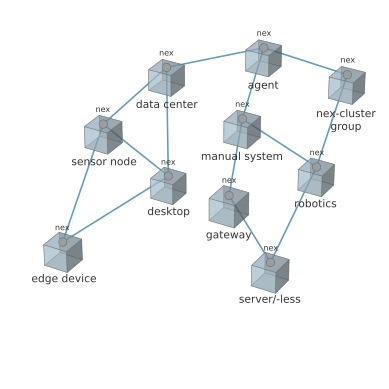
Every platform dependency is a vulnerability. API changes, price increases, and service shutdowns are vectors of disarmament against your autonomy. A single state machine makes any storage backend interchangeable, turning platform lock-in into a tactical choice rather than an architectural constraint.
Data remains readable by the same code a decade later, regardless of which platform hosted it. Platform independence is a survival strategy, and neXus is its fabric.
The ecosystem grows by stigmergy: solving a problem deposits verified knowledge back into the shared store, and other producers inherit it. Value compounds with knowledge depth rather than with raw compute.
One coordinate space, one protocol, multiple directions, no orchestration.
neXus began as the proof of concept of the SSCCS computational model; the platform and the theory describe each other by design. It is a peer fabric rather than a platform: no marketplace, no extension rent, no central gatekeeper. A producer runs nex on their own infrastructure and decides what their work is worth.
Every interaction in neXus is expressed through three primitives, forming a recursive, self-similar cycle across all scales (agent, experiment, project, ecosystem):
submit → claim → heartbeat → conclude.
Every Fact carries a provenance hash linking it to its originating Intent, forming a deterministic, replayable audit trail. A core rule governs scale: Observe as Fact, act as Intent. Automated observers record findings as Facts, preventing the Blackboard from cluttering with unclaimed Intents.
All participants (verification engines, editors, synthesis tools) are equal peers interacting solely via the FIH Blackboard interface. There is no privileged orchestrator layer; peers are defined by their role (what they read/write), not hierarchy.

Bridging the architecture layers to actual execution, nexd is the native daemon that maintains the FIH blackboard as a persistent process and orchestrates agent application lifecycles. It provides Unix socket IPC for local clients, process spawn/monitor/kill for child agents, and an OODA scheduler for heartbeat monitoring and stale intent eviction.

| Layer | Logical Component | Core Responsibility |
|---|---|---|
| 1 | Knowledge Graph Engine | Hybrid retrieval (vector + graph + temporal) for documents, entities, simulations, and sensor traces. |
| 2 | Artifact Ingestion Pipeline | Decoupled, engine-agnostic sync (Object Store → Sync Worker → Queue) ensuring incremental, consistent updates. |
| 3 | Agentic Research Loop | Stigmergy-based coordination. Planner, Verifier, and Generator interact solely via the FIH Blackboard. |
| 4 | Learning Loop | On-policy RL (Flow-GRPO) optimizing the Planner using knowledge-graph support, novelty, and reproducibility rewards. |
| 5 | Contract Governance | On-chain, self-executing protocol defining evidence thresholds, research economy rules, and staking mechanisms. |
Specification: the neXus, neXus, neXus, and neXus are detailed in the neXus.
FIH primitives form a 3-vector basis for the system state, enabling three scaling modes:
Fundamental computing research requires validation beyond text and code. neXus extends into a cross-reality research manifold, unifying theoretical insights, simulation outputs, and physical measurements.
The Universal Latent Isomorphic Manifold (ULHM) framework uses isomorphism (continuous bijection preserving topological structure) to unify disparate modalities. The Verifier applies three canonical loss terms to validate cross-domain mappings:
| Layer | Current Scope | Extended Scope |
|---|---|---|
| KG Engine | Documents, code, references | Simulation outputs, robot trajectories, sensor streams, digital twin states |
| Ingestion Pipeline | Text files (.md, .rs, etc.) |
Binary simulation results, point clouds, telemetry, hardware-in-the-loop data |
| Agentic Loop | Document-code gap hypotheses | Hypotheses spanning simulation predictions and physical measurements |
| Learning Loop | Research session outcomes | Experimental validation rates, simulation fidelity, physical reproducibility |
| Contract Governance | Structural/citation rules | Physical constraints, precision bounds, safety invariants |
| Component | KG Engine | Object Store | Sync Worker | Planner | Verifier | Generator | Sim / Hardware |
|---|---|---|---|---|---|---|---|
| KG Engine | ● | ← synced by | ← queried by | ← grounds | ← ingests traces | ||
| Object Store | ● | ← read during diff | ← uploaded by | ||||
| Sync Worker | → del/upd | → list/read | ● | ||||
| Planner | → queries | ● | → delegates | → invokes | |||
| Verifier | → hybrid + isomorphic | ← receives | ● | → signals | ← validates | ||
| Generator | ← triggered | ● |
© 2026 SSCCS Initiative — Open-source computing systems initiative building a computing model, software compiler infrastructure, and open hardware architecture.