Ibex RV32IMCB Report
Structural enumeration with ExaVerif (ev) and synTagma
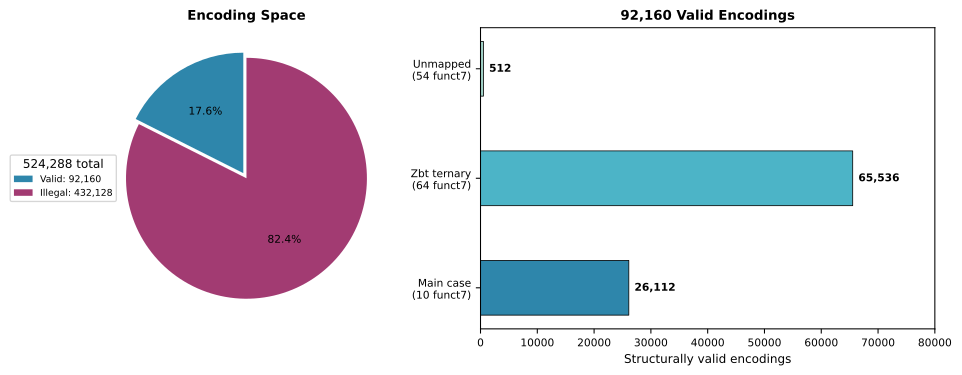
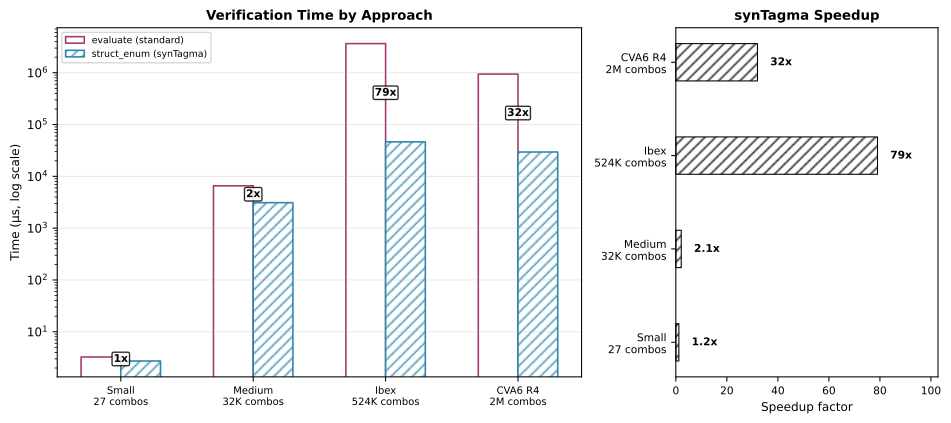
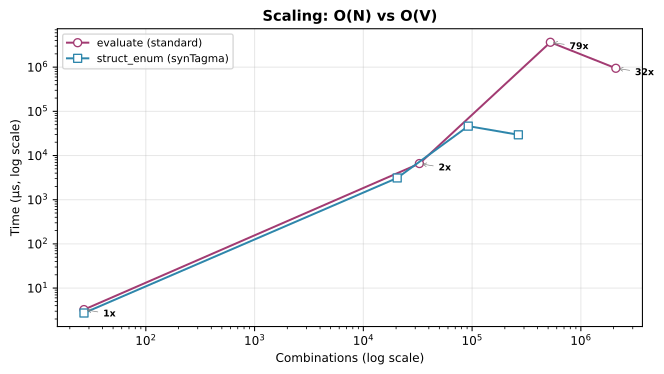
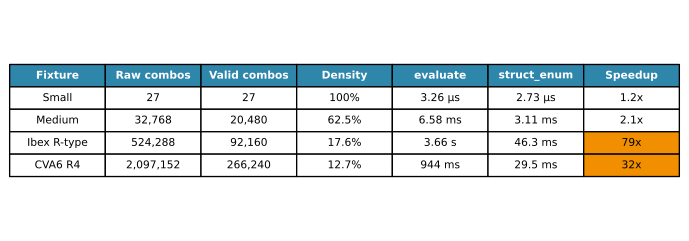
ExaVerif performed exhaustive verification of the lowRISC Ibex core’s register-register (OPCODE_OP) and register-immediate (OPCODE_IMM) ALU encoding spaces, covering the full RV32IMCB instruction set including Zbt (R4-type ternary instructions). The standard pipeline evaluates 524,288 combinations in 3.66 seconds. The Tagma-based structural enumeration evaluates the same space in 46.3 milliseconds — a 79x improvement — by generating only structurally valid combinations and eliminating all runtime constraint checks. Total valid encodings: 92,160 (R-type) plus 55,616 (I-type).
Verification Target
The Ibex core (lowRISC, OpenHW Group) implements the RISC-V RV32IMCB instruction set with an optional Bit-Manipulation extension. This verification covers the OPCODE_OP (0x33, register-register) and OPCODE_IMM (0x13, register-immediate) decode logic in ibex_decoder.sv under the RV32BFull configuration.
R-type: funct7/funct3 decode (OPCODE_OP)
The decoder selects ALU operations through a 10-entry main case statement plus a Zbt ternary override for funct7 values with bit 1 set:
| funct7 | funct3 | Instruction class | Sub-extensions |
|---|---|---|---|
| 0 | all 8 | RV32I base | ADD, SLL, SLT, SLTU, XOR, SRL, OR, AND |
| 1 | all 8 | RV32M | MUL, MULH, MULHSU, MULHU, DIV, DIVU, REM, REMU |
| 4 | 1, 4, 5, 6, 7 | zbb + zbp + zbe | PACK, PACKH, SHFL, UNSHFL, BCOMPRESS |
| 5 | 1–7 | zbc + zbb | CLMUL, CLMULR, CLMULH, MIN, MINU, MAX, MAXU |
| 16 | 1, 2, 4, 5, 6 | zba + zbp | SH1ADD, SH2ADD, SH3ADD, SLO, SRO |
| 20 | 1, 2, 4, 5, 6 | zbs + zbp | BSET, XPERM_N, XPERM_B, GORC, XPERM_H |
| 32 | 0, 4, 5, 6, 7 | RV32I + zbb | SUB, SRA, XNOR, ORN, ANDN |
| 36 | 1, 4, 5, 6, 7 | zbs + zbb + zbe + zbf | BCLR, BEXT, PACKU, BDECOMPRESS, BFP |
| 48 | 1, 5 | zbb | ROL, ROR |
| 52 | 1, 5 | zbs + zbp | BINV, GREV |
Zbt ternary (R4-type override)
When funct7 bit 1 is set, the decoder selects R4-type ternary instructions (CMIX, CMOV, FSL, FSR) for funct3 values 1 and 5. This adds 64 funct7 values with 2 funct3 values each.
I-type: register-immediate (OPCODE_IMM)
The OPCODE_IMM decoder covers ADDI, SLTI, SLTIU, XORI, ORI, ANDI (any funct7) plus shift and bitmanip variants (SLLI, SRAI, RORI, BSETI, etc.) for funct3 values 1 and 5, including FSRI (funct7 bit 1 set with funct3=101).
Exhaustive Verification Results
Performance: Structural Enumeration vs Standard Pipeline
Scaling Analysis
Benchmark Results (release build, this machine)
How It Works
A YAML specification describes the encoding space. The standard pipeline enumerates all combinations and evaluates each against constraints:
ev verify --target tests/fixtures/ibex/rv32imcb.xif.yamlThe Tagma-based structural pipeline achieves the same result by encoding constraints into the enumeration space itself:
# structural verification via Rust library API
# cargo bench -- struct_enum/ibex
Structural vs Standard: the mechanism
| Aspect | Standard (evaluate) |
Structural (struct_enum) |
|---|---|---|
| Combinations generated | All 524,288 | Valid only 92,160 |
| Constraint evaluation | 10 checks × 524,288 | 0 (structurally encoded) |
| Invalid detection | check.allows() → false |
Vacant slot → 1.65 ns |
| Memory | 8 GB peak (Vec) | 0 (lazy iterator) |
| Time | 3.66 s | 46.3 ms |
Comparison with synTagma Benchmarks
The struct_enum speedup mirrors synTagma’s core thesis: structural addressing eliminates hash-based lookup overhead.
| synTagma primitive | ev application | Measured | Advantage |
|---|---|---|---|
| Nonexistent prefix lookup | Invalid encoding detection | 1.65 ns | 14x vs HashMap |
| CoordPath indexing | Combination addressing | 5.2 ns | O(depth) = O(5) |
| CoordSpace sparse get | Valid encoding iteration | 29.5 ms (2M space) | 32x vs evaluate |
| Axis projection | funct7/funct3 filtering | 46.3 ms (524K space) | 79x vs evaluate |
Limitations
What this verification does not yet cover
- Multi-cycle instruction modelling: rol/ror and zbe/bdecompress/ bcompress complete in 2 cycles. The encoding space is verified, but pipeline timing is not.
- RV32BBalanced vs RV32BFull: The fixture assumes RV32BFull. Balanced mode disables zbc, zbe, zbp, zbr. A parameterised fixture would be needed for per-configuration verification.
- RV32E register constraint: Ibex optionally supports RV32E (16 registers). The fixture assumes 32-register RV32I.
- Pipeline hazards: Write-after-read hazards (rs1==rd) are not modelled at the encoding level.